A Window to the Universe
The National Observatory of Athens (NOA), founded in 1842, holds a unique place in history as the first research centre established in Greece and south-eastern Europe. It dominates the summit of the historic Hill of the Nymphs in Thisio, offering visitors a magnificent and unobstructed view of the Acropolis and the Ancient Agora, and plays a crucial role in the fields of astronomy, geophysics, seismology, and meteorology.
Architecture and History
The iconic central building owes its existence to the generous funding of the national benefactor, Baron Georgios Sinas. Completed in 1846, it was designed by the renowned Danish architect Theophil Hansen. A characteristic feature of its architecture is its cruciform shape, with the four wings precisely aligned with the four points of the horizon, symbolising the universality of science.
The Museum and the Map of the Moon
At the Visitor Centre, both children and adults can explore the Museum of Geoastrophysics. It houses a rich collection of scientific instruments from the 19th and 20th centuries, as well as an impressive library of rare historical documents. The most significant exhibit is located under the dome of the Sinas building: the original 16-centimetre telescope. Using this instrument, Julius Schmidt, the third director of the foundation, created the most detailed and accurate map of the Moon of the era in the 19th century.
The Doridis Telescope Experience
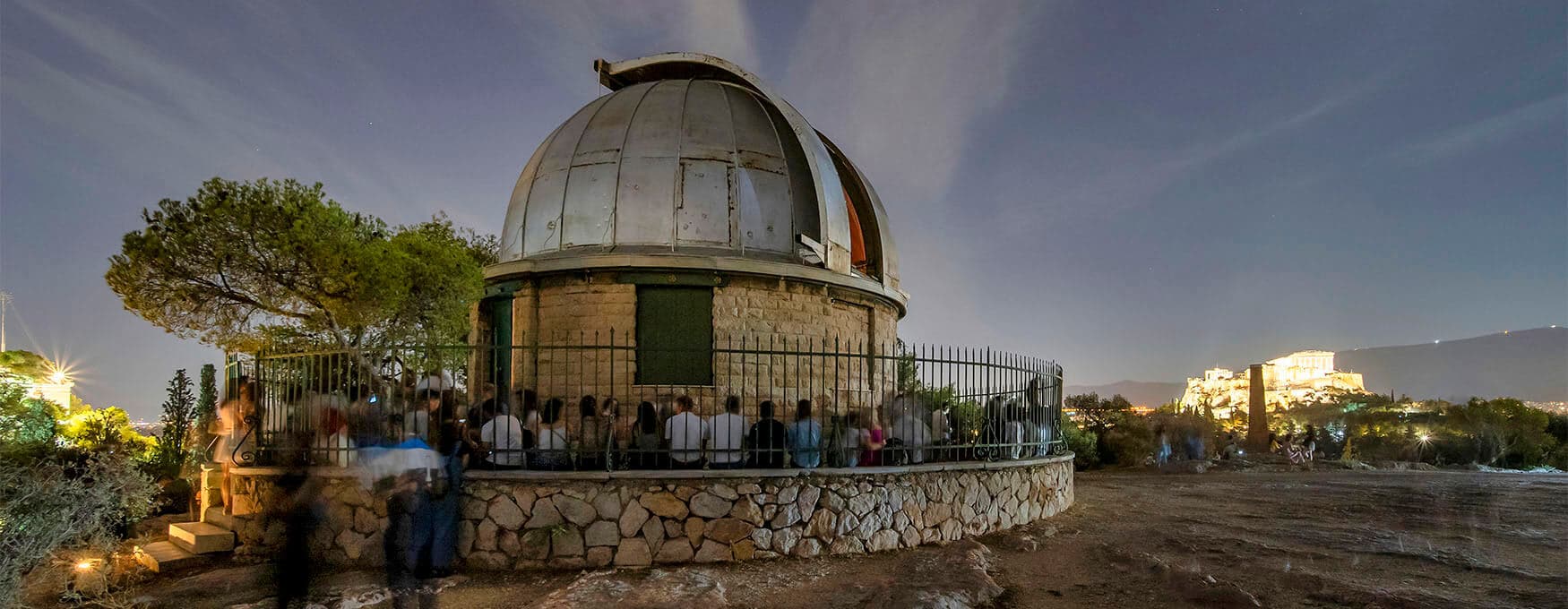
The ideal conclusion to a visit is seeing the Doridis telescope, housed in a unique circular chamber. Evening tours offer the public a unique opportunity to observe the night sky of Attica and the stars through its lens.
An interesting historical detail that many are unaware of is that until the mid-1960s, the official time in Greece was determined exclusively by the Observatory, through the meridian telescope named after Andreas Syngros.
Architecture and History
The iconic central building owes its existence to the generous funding of the national benefactor, Baron Georgios Sinas. Completed in 1846, it was designed by the renowned Danish architect Theophil Hansen. A characteristic feature of its architecture is its cruciform shape, with the four wings precisely aligned with the four points of the horizon, symbolising the universality of science.
The Museum and the Map of the Moon
At the Visitor Centre, both children and adults can explore the Museum of Geoastrophysics. It houses a rich collection of scientific instruments from the 19th and 20th centuries, as well as an impressive library of rare historical documents. The most significant exhibit is located under the dome of the Sinas building: the original 16-centimetre telescope. Using this instrument, Julius Schmidt, the third director of the foundation, created the most detailed and accurate map of the Moon of the era in the 19th century.
The Doridis Telescope Experience
The ideal conclusion to a visit is seeing the Doridis telescope, housed in a unique circular chamber. Evening tours offer the public a unique opportunity to observe the night sky of Attica and the stars through its lens.
An interesting historical detail that many are unaware of is that until the mid-1960s, the official time in Greece was determined exclusively by the Observatory, through the meridian telescope named after Andreas Syngros.