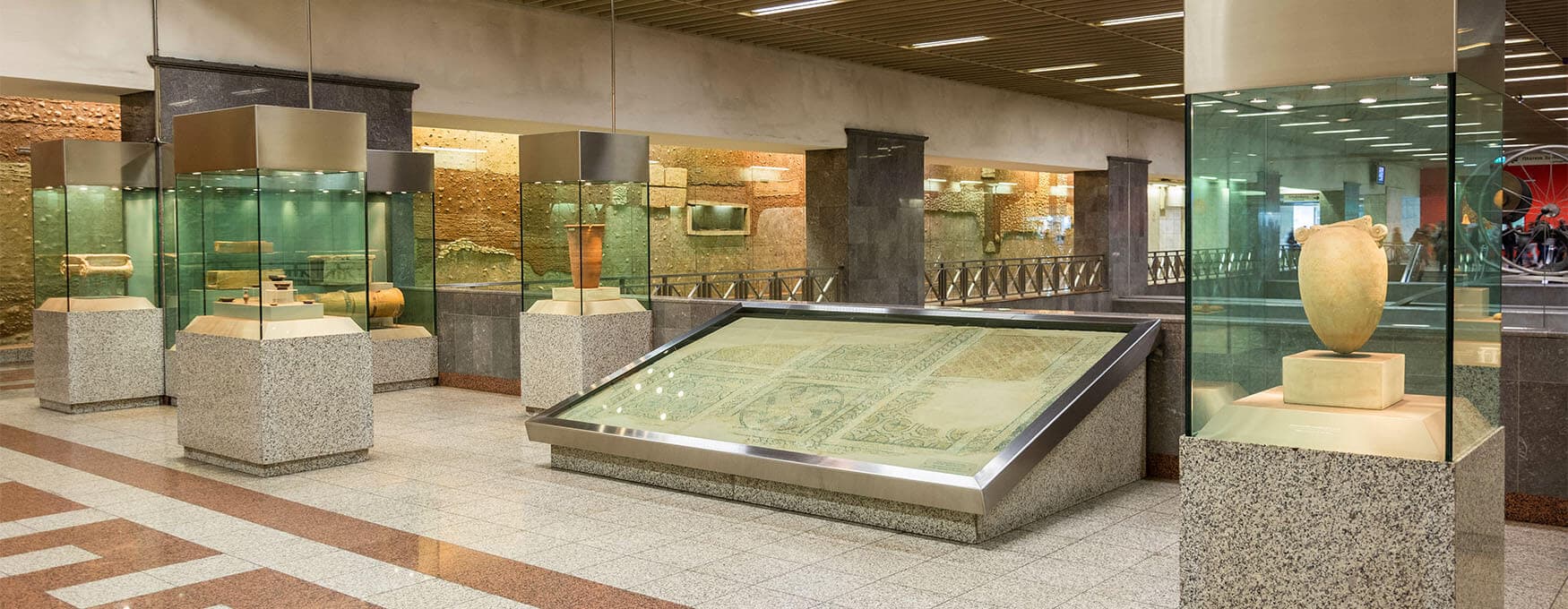
An Underground Journey Through Time
Did you know that your daily commutes in Athens conceal the largest archaeological project in the country? With over 50,000 finds, several metro stations now operate as free underground museums. Simply stopping, you can relish a rare glimpse into antiquity: admire replicas of the Parthenon’s decorations, Panathenaic amphorae, ancient children’s toys, and sections of the oldest bridge ever found in Attica.
Museum - Stations
At Syntagma Station, visitors can study the city’s stratigraphy, dating from the 5th century BC to the Ottoman period. Highlights include the burial of a young woman, the mosaic floor of an ancient house, and the pipes of the water supply system. At Monastiraki Station, you can see the enclosed bed of the ancient river Eridanos, which continues to flow to this day, while at Eleonas Station, three pillars of the oldest bridge found in Greece (5th-6th centuries BC) are on display.
At Egaleo Station, near a section of the ancient Iera Odos (Sacred Way), figurines, lamps, and a striking cast of a horse attempting to escape a flood of the Kifisos River are on display. The Acropolis Station features impressive replicas of the Parthenon’s frieze. Its display cases exhibit ancient children’s toys, pointed-bottomed amphorae, and a representation of a loom, while the exit is dominated by the figures of the Parthenon’s eastern pediment depicting the birth of Athena.
Other Important Finds
The archaeological experience continues Evangelismos Station with the Peisistratian aqueduct, at Dafni Station with the remains of ancient farmsteads, and at Panepistimio Station with a diverse range of funerary finds.
The Athens Metro is not merely a means of transport, but a living exhibition that links the daily life of modern Athenians with the public and private lives of their ancestors. Access to these ‘underground jewels’ is free to the public, making historical knowledge a part of our daily commute.
Museum - Stations
At Syntagma Station, visitors can study the city’s stratigraphy, dating from the 5th century BC to the Ottoman period. Highlights include the burial of a young woman, the mosaic floor of an ancient house, and the pipes of the water supply system. At Monastiraki Station, you can see the enclosed bed of the ancient river Eridanos, which continues to flow to this day, while at Eleonas Station, three pillars of the oldest bridge found in Greece (5th-6th centuries BC) are on display.
At Egaleo Station, near a section of the ancient Iera Odos (Sacred Way), figurines, lamps, and a striking cast of a horse attempting to escape a flood of the Kifisos River are on display. The Acropolis Station features impressive replicas of the Parthenon’s frieze. Its display cases exhibit ancient children’s toys, pointed-bottomed amphorae, and a representation of a loom, while the exit is dominated by the figures of the Parthenon’s eastern pediment depicting the birth of Athena.
Other Important Finds
The archaeological experience continues Evangelismos Station with the Peisistratian aqueduct, at Dafni Station with the remains of ancient farmsteads, and at Panepistimio Station with a diverse range of funerary finds.
The Athens Metro is not merely a means of transport, but a living exhibition that links the daily life of modern Athenians with the public and private lives of their ancestors. Access to these ‘underground jewels’ is free to the public, making historical knowledge a part of our daily commute.